How to Start Practising Witchcraft
Begin your journey into witchcraft with simple
Free shipping for orders over £75
A free one-of-a-kind collectable gift with every purchase above £25
A hedge witch is perhaps the oldest type of witch there is, and one of the most quietly powerful. If you’ve ever felt most at home at the edge of a forest, most yourself in the early morning before the world wakes up, most alive when your hands are in the soil or your face is turned towards the wind, you may already know what it feels like to walk this path.
In this guide, we’re going to explore what a hedge witch is, where the tradition comes from, what hedge witchcraft looks like in practice, and how to know whether this is the path that’s calling you.
A hedge witch is a solitary practitioner who works at the boundary between the everyday world and the unseen, between the physical and the spiritual, the known and the unknown.
The word hedge is key. In the old world, the hedge was a literal boundary; the line of trees and tangled growth that marked the edge of the village, beyond which the wild world began. The hedge was the threshold. The hedge witch was the person who lived and worked at that threshold, moving between the two worlds with knowledge, skill, and intention.
Hedge witches are typically solitary. They don’t tend to work in covens or follow a specific spiritual tradition. Their practice is rooted in the natural world, in plants, in the land, in the rhythms of the seasons, and in a deep, personal relationship with the unseen energies around them.
A hedge witch is not defined by what they believe. They are defined by how they work; close to the earth, close to the boundary, and close to their own intuition.
Hedge witchcraft is one of the oldest forms of folk magic in the world. Long before witchcraft became associated with any particular tradition or religion, there were the village healers, the wise men, women and cunning folk who knew which herbs to use for a fever, which words to speak over a wound, which plants grew where, and which times of year held the most power.
These were the hedge witches. They were the people their communities turned to for healing, for protection, for guidance at the turning points of life: birth, illness, grief, death. They worked alone, often outside the formal structures of society, drawing their knowledge from the land itself and from wisdom passed down through generations.
The term hedge witch in its modern form was popularised in the late twentieth century, but the practice it describes is ancient. It predates Wicca, predates organised witchcraft traditions, and exists independently of any religious framework. It is, at its core, a practice of relationship — with nature, with place, with the unseen.
A hedge witch’s practice is shaped by their relationship with the natural world. It tends to draw on herbs and plants, the land and the seasons, and a deep inner attunement that develops over time.
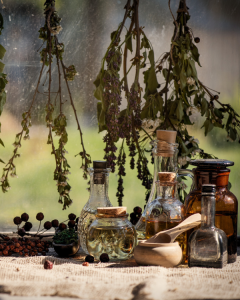
Most hedge witches have a deep relationship with plants. This isn’t simply knowing which herb does what — it’s a living, ongoing conversation with the green world. A hedge witch gathers, grows, and works with plants as living allies, each with their own energy, their own gifts, their own wisdom.
Common herbs in hedge witch practice include mugwort (for dreaming, vision, and boundary-crossing), rosemary (for protection and clarity), yarrow (for healing and courage), elder (for protection and transition), and whatever grows wild and abundant in the place where the hedge witch lives.
At Fire & Fern, many of the botanicals in our candles and incense are gathered from the wild land of Cumbria — the same approach a hedge witch might take: working with what the land offers, in season, with respect.
A hedge witch’s year is shaped by the natural calendar — the wheel of the year, the turning of the seasons, the movements of the moon. Not necessarily as religious observance, but as a way of staying attuned to the rhythms of the living world.
Samhain (the end of October) is particularly significant for the hedge witch — it’s the time when the boundary between worlds is thinnest, and the edge-walking work of the hedge witch feels most alive. But every season holds its own medicine: the fresh beginnings of spring, the full abundance of summer, the turning inward of autumn, the stillness of winter.
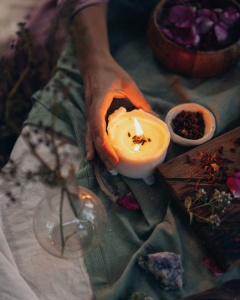
The hedge witch works alone. Their rituals are personal, often simple, and shaped by their own intuition rather than prescribed tradition. A hedge witch might light a candle at dusk and sit with whatever arises. They might go to a particular tree or stone or stretch of water again and again, building a relationship with that place over years. They might keep a dream journal, work with smoke and herbs to shift the energy of a space, or spend time each day in quiet attention to the world around them.
This is a practice of deep listening. The hedge witch is not performing magic for an audience — not even for a coven. They are developing their own relationship with the unseen, in their own way, on their own terms.
Not quite — though there’s real overlap. Both the hedge witch and the green witch work closely with plants and the natural world, and both tend to be solitary practitioners.
The key difference is in the focus. A green witch’s practice centres primarily on plant magic, herbalism, and the energy of the living green world. A hedge witch’s practice centres on the boundary — on the liminal space between worlds, on crossing thresholds, on the relationship between the seen and unseen.
In practice, many witches embody elements of both. There are no strict rules here. If you feel drawn to the herbs and the hedge both, that is simply your practice taking the shape it needs to.
The hedge witch path tends to call to certain kinds of people. You might be drawn to hedge witchcraft if:
None of these are requirements. The hedge witch path is, above all, a path of personal relationship and intuition. If something in this description resonates, trust that resonance.
You don’t need to declare yourself a hedge witch to walk this path. You simply begin — and the practice will reveal itself as you go.
Start with your local landscape. Go outside. Pay attention to what grows near you, what birds visit, what the sky looks like at dusk. Begin building a relationship with the land where you actually live, not an idealised version of it.
Learn one plant at a time. Choose a plant that grows near you or that you’re drawn to. Read about it, grow it if you can, use it — in cooking, in ritual, in a simple candle spell. Let that one plant become a companion before you move to the next.
Create a simple daily practice. Light a candle at dusk. Step outside each morning and simply breathe. Keep a journal of what you notice — in the world, in your dreams, in your energy. These small acts of attention are the foundation of the hedge witch’s path.
Work with the moon and the seasons. You don’t need elaborate ceremonies. Simply noticing — when the moon is new, when it’s full, when the seasons turn — is enough to begin aligning your own rhythms with those of the living world.
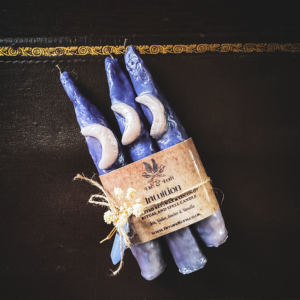
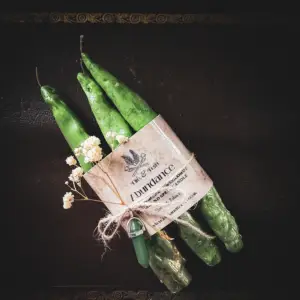
Our handmade ritual candles at Fire & Fern are crafted with wild-gathered Cumbrian botanicals — mugwort, rosemary, yarrow, and more. They’re made for exactly this kind of quiet, intentional work. Explore our [ritual candle collection] and find one that speaks to where you are.
Do hedge witches follow a religion? No — hedge witchcraft is a practice, not a religion. Hedge witches may be pagan, animist, spiritual-but-not-religious, or hold no particular beliefs at all. What defines the hedge witch is how they work, not what they believe.
Do I need to learn to hedge ride? “Hedge riding” — a form of shamanic journeywork in which the practitioner enters a trance state to travel between worlds — is associated with some hedge witch traditions. But it is not required. Many hedge witches never work with trance states and have a rich, full practice without it.
Can I be a hedge witch if I live in a city? Yes. The hedge is a metaphor as much as a physical place. You can find the edge in a park, a window box of herbs, the changing light at dusk, the gap between buildings where something wild is growing. The practice adapts to where you are.
Is a hedge witch the same as a cunning woman? The cunning folk were historical practitioners of folk magic in Britain and Europe — healers, diviners, and charmers who often worked for their communities. The hedge witch shares roots with this tradition, though the modern hedge witch practice is more inward and personal than the community-facing role of the historical cunning woman or cunning man.
How is a hedge witch different from a Wiccan? Wicca is a specific religious tradition with its own structure, theology, and practice. Hedge witchcraft is not a religion and has no fixed structure. Many Wiccans incorporate hedge witch elements into their practice, and some hedge witches are also Wiccan — but the two are distinct. Hedge witchcraft predates Wicca by centuries.
The hedge witch has always known what takes longer for the world to learn: that the most interesting things happen at the edges. At the boundary between forest and field. Between sleep and waking. Between this world and the one that breathes behind it.
If you’re drawn to the threshold — if you’ve always felt that the edge is where you belong — you may already be walking the hedge witch path. You may have been walking it all along.
At Fire & Fern, we make handmade ritual candles, spell kits, and incense holders using natural botanicals — many wild-gathered from the land of Cumbria. Our work is rooted in the same love of the natural world that sits at the heart of hedge witchcraft. Explore our shop and find the pieces that feel like yours.
Begin your journey into witchcraft with simple

Spells and rituals- are they the same
Discover simple witch rituals to begin your

A hedge witch walks the boundary between

Sign up to receive offers and new products before anyone else.